Annealed Glass: What It Is, How It’s Made, and When to Use It

In the architectural and glazing industries, you will hear a variety of specialized terms: tempered, laminated, heat-strengthened, and more. However, almost every single one of these high-performance glass products starts its life as one fundamental material: annealed glass.
Often referred to as standard glass, raw glass, or float glass, annealed glass is the baseline product of the glass world. It is highly versatile, cost-effective, and easy to customize on-site. However, because it lacks the intense structural strength of treated glass, using it in the wrong application can result in severe safety violations and dangerous structural failures.
In this comprehensive architectural guide, we break down what annealed glass is, how the annealing process works, its core benefits and limitations, and exactly when you should—and should not—use it in your building projects.
1. What Is Annealed Glass? (The Science of Controlled Cooling)
To understand annealed glass, we must look at how glass behaves when it transitions from a molten liquid to a solid pane.
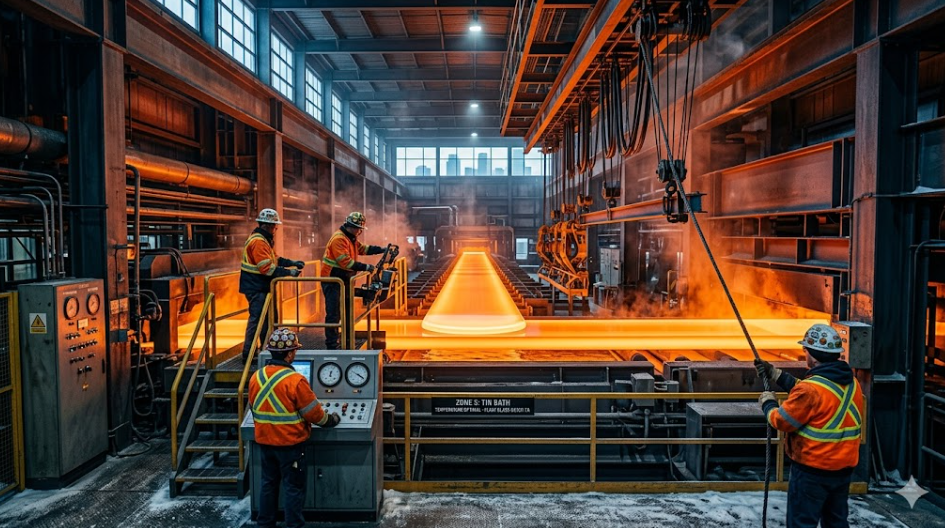
All standard glass begins as a liquid mixture of silica sand, soda ash, and lime heated to over $1500\text{ }^{\circ}\text{C}$. Once the glass sheet is formed (typically by floating the molten glass on a bed of liquid tin), it must be cooled down.
If hot glass cools too rapidly, the outer surfaces will contract and solidify much faster than the hot inner core. This temperature mismatch locks massive, unstable internal thermal stresses into the glass. Untreated glass cooled in this chaotic way is highly unstable and will shatter violently if you attempt to cut, drill, or even lightly tap it.
The Annealing Process
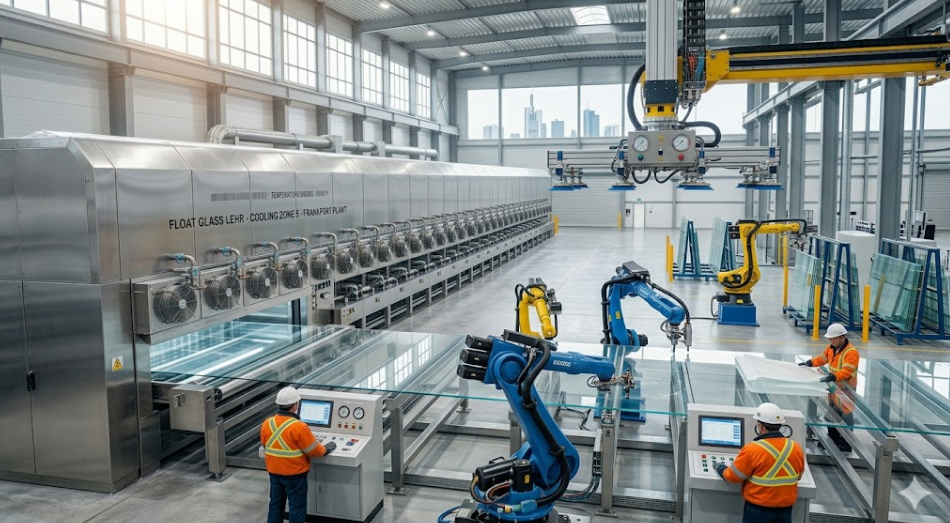
To prevent this instability, manufacturers pass the hot glass ribbon through a long, temperature-controlled tunnel called a lehr. This slow and controlled thermal treatment is the foundational baseline for creating specialized Laminated Glass Panels.
- The glass is kept at a constant temperature of approximately $500\text{ }^{\circ}\text{C}\text{ to }550\text{ }^{\circ}\text{C}$ to allow its molecular structure to stabilize.
- It is then cooled down to room temperature at an incredibly slow, highly regulated rate.
- This slow cooling relieves all internal thermal stresses, leaving a stable, uniform sheet of glass.
The resulting product is annealed glass—stable, stress-free, and ready for fabrication.
2. Key Characteristics and Advantages
Annealed glass remains the most widely manufactured type of glass in the world due to several outstanding properties:
Exceptional Workability (On-Site Customization)
Unlike fully tempered glass (which instantly shatters if drilled or cut), annealed glass can be easily cut, scored, drilled, notch-cut, and edge-polished after it has been manufactured. Glaziers can bring large stock sheets of annealed glass directly to a job site and cut them to custom sizes on-demand.
Excellent Cost-Efficiency
Because it does not undergo secondary thermal processing (like tempering) or bonding cycles (like lamination), annealed glass is the most economical glass type available. This makes it the go-to option for large-scale glazing where budgets are tight and safety glass is not legally required.
High Optical Clarity
Annealed glass offers superb visual clarity and flat-surface quality. When manufactured at thin profiles (such as $2\text{mm}$ to $4\text{mm}$), it has practically no distortion and excellent light transmission.
3. The Core Limitation: Breaking Patterns and Safety Risks
Despite its cost-effectiveness, annealed glass carries a major safety vulnerability. When annealed glass is struck with enough force to fracture, it breaks into large, razor-sharp, dagger-like shards.

These heavy, sharp shards do not stay in place; they fall away instantly, acting as gravity-driven blades that can cause life-threatening lacerations.
- Safety Rating: Because of this hazard, annealed glass is not classified as safety glazing.
- Thermal Stress Vulnerability: Annealed glass has low resistance to rapid temperature changes. If one half of a pane gets extremely hot in direct sunlight while the other half remains cold in a shadow, the uneven expansion can easily cause a thermal crack to spiderweb through the panel. To handle extreme structural and thermal stress, builders must transition to premium Heat-Treated Glass solutions.
4. Comparing Glazing Materials at a Glance
Architects and project specifiers must carefully weigh properties like cost, safety, and site-workability. Compare how raw glass stacks up against safety panels:
| Property | Annealed Glass (Raw) | Fully Tempered Glass (FT) | Laminated Glass (PVB/SGP) |
|---|---|---|---|
| Relative Strength | Baseline ($1\times$) | $4\times\text{ to }5\times$ stronger | Highly impact-resistant |
| Break Pattern | Large, sharp, dangerous shards | Tiny, blunt, granular cubes | Remains bonded to polymer interlayer |
| Can Be Cut On-Site? | Yes | No (shatters instantly) | No (must be cut before lamination) |
| Safety Glass Rating | No | Yes (Certified) | Yes (Certified) |
| Thermal Resistance | Low | High | High |
| Relative Cost | Lowest (Budget-friendly) | Moderate | Premium |
5. When to Use Annealed Glass (Best Applications)
Because of its safety limits, annealed glass should only be installed in low-risk, protected, or decorative environments where human impact is highly unlikely.
Ideal Low-Risk Applications
- Mirrors: Standard wall-mounted bathroom and dressing mirrors are typically made of annealed glass because they are fully supported by backing walls.
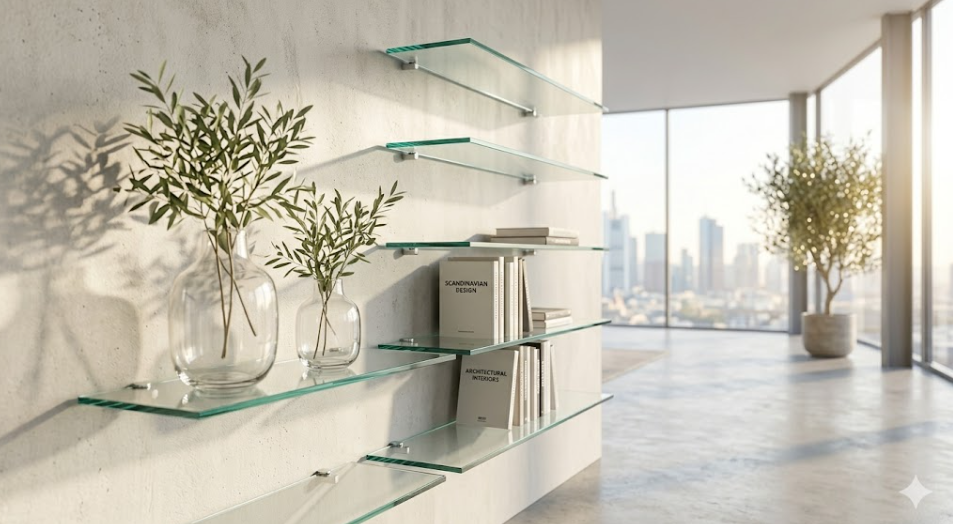
- Cabinet Doors & Furniture Glass: Perfect for glass-fronted kitchen cabinets, decorative shelving, and tabletop glass protectors (when supported fully by solid wood underneath).
- Picture & Artwork Frames: Thin annealed glass (typically 2mm to 3mm thick) provides crystal-clear protection for framed photos and art.
- Standard Windows in Low-Traffic Areas: High-level small windows or interior transom windows where there is no danger of anyone falling against them.
- The Base for Advanced Glass: Annealed glass is the essential starting material that is shipped to fabrication plants to be heat-treated into tempered glass or laminated into structural safety glass.
6. When You Must Avoid Annealed Glass (Code Violations)
Municipal building codes, including the Ontario Building Code (OBC), strictly ban the use of annealed glass in "hazardous locations." In these areas, only tempered or laminated safety glass is permitted.
Do Not Use Annealed Glass For
- Glass Railings & Guardrails: If a railing fails, a person can fall through. Annealed glass must never be used for balustrades. Safe structures require heavy engineering such as Glass Railings.
- Shower Enclosures & Tub Doors: Wet, slippery environments carry a high risk of slips and falls. Using raw glass here is extremely dangerous.
- Doors & Adjacent Sidelites: Any glass panel located within 18 inches (approx. 45cm) of a door or close to the floor must be safety glazing to prevent impact if someone accidentally walks into it.
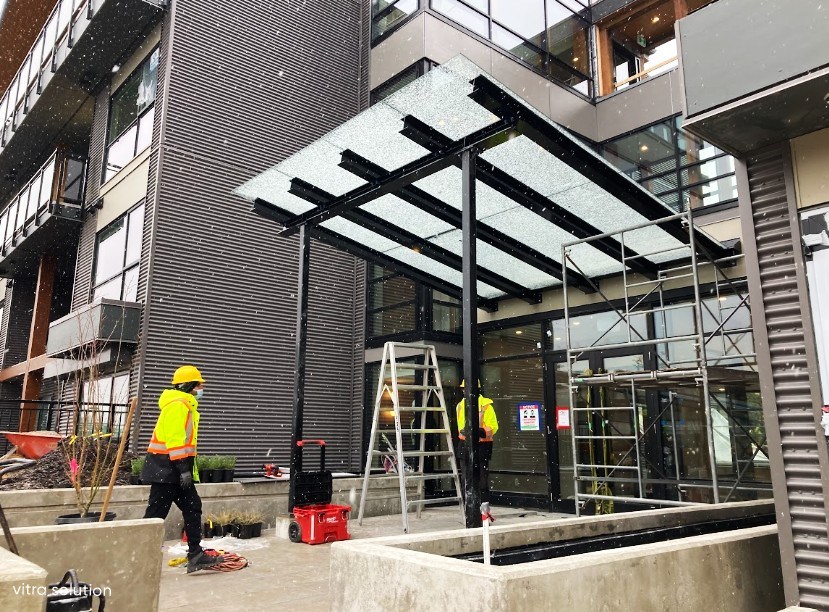
- Overhead Canopies & Skylights: Overhead glass requires high post-breakage retention to prevent falling shards from injuring people below. Consider utilizing laminated layers or a durable Glass Canopy system.