
Glass Canopy Installation: Site Safety, Building Codes, and Equipment Requirements

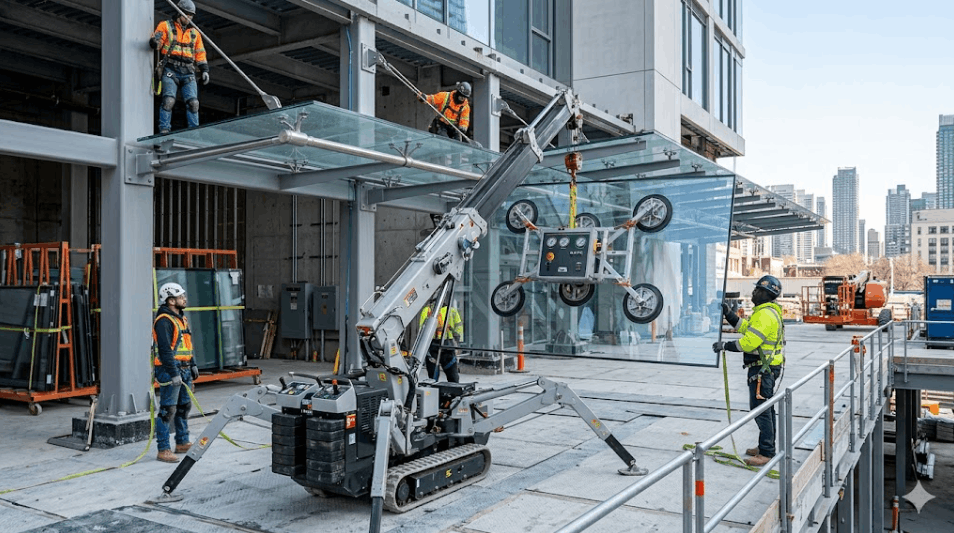
While structural glass canopies are celebrated for their minimalist aesthetic and floating appearance, installing these heavy systems overhead is a highly complex and structurally sensitive operation.
From managing wind forces during lifting to ensuring heavy glass fragments are securely anchored to the building's load-bearing walls, canopy installation leaves zero margin for error. A successful installation requires meticulous safety planning, strict compliance with municipal building codes, and the use of specialized lifting machinery.
In this professional guide, we explore the essential safety practices, structural building codes, and advanced rigging equipment required to deliver a secure and durable glass canopy installation.
1. Site Safety Protocols During Installation
Glass canopy installation typically involves heavy lifting at heights, often above active pedestrian walkways or busy building entrances. Establishing a comprehensive site safety plan prior to mobilization is critical to protecting both the installation crew and the public.
Conducting a Site Hazard Assessment
Before any equipment arrives on site, a thorough hazard assessment must be completed. This evaluation identifies structural risks on the building facade, potential wind hazards, overhead power lines, and site access limitations.
Establishing Controlled Work Zones
Overhead work introduces the risk of falling tools or materials. Installers must secure the area below by:
- Setting up clear physical barriers, warning signs, and safety tape.
- Deploying protective hoarding or overhead pedestrian bridges if the entrance must remain partially active during construction.
- Restricting access to the active rigging zone exclusively to certified personnel.
Safe Glass Handling Techniques
Thick laminated glass panels are highly sensitive to edge damage. If a panel is bumped or dropped on its corners during handling, microscopic fractures can form, leading to premature structural failure or spontaneous shattering during or after installation. Crews must use padded edge protectors and specialized storage racks until the glass is fully secured.
2. Compliance with Building Codes and Load Transfer
An architectural glass canopy is not simply a decorative addition; it is a structural roof extension that must comply with local regulations, such as the Ontario Building Code (OBC).
Primary Engineering Considerations
To receive structural engineering approval (and the required P.Eng. stamp), a canopy design must satisfy several load-bearing criteria:
- Dead Loads: The continuous downward force exerted by the weight of the glass panels and metal hardware.
- Live Loads (Snow & Ice): The temporary but immense weight of winter snow accumulation and sliding ice from upper stories.
- Wind Uplift & Pressure: Wind tunnel effects that can violently pull the canopy upward or push it downward.
- Load Transfer: The installation method must transfer these combined forces safely through the brackets and anchors directly into the building’s primary structural columns or floor slabs—never into thin cosmetic brick veneers or siding.
The Laminated Safety Glass Mandate
Under modern building codes, laminated safety glass is the absolute standard for overhead glazing. If an object falls from above and cracks the canopy, the glass fragments must remain adhered to the internal polymer interlayer (PVB or SGP). This post-breakage integrity prevents dangerous glass fallout from showering down onto the entrance below.
3. Equipment Selection: Residential vs. Commercial Installations
The scale of the project, building height, and site layout dictate what equipment must be deployed for a safe and efficient installation.
Residential Installations
Residential glass canopies are usually smaller, single-panel systems designed to protect front doors or patios. These projects typically rely on compact, agile equipment:
- Manual Glass Lifters & Vacuum Cups: Hand-held suction cups used by a small team to position panels up to 100 kg.
- Mobile Scaffolding: Light aluminum towers that provide safe, stable working platforms at low heights.
- Portable Material Lifts: Hand-cranked lifts that support the weight of the glass while installers secure the wall brackets.
Commercial Installations
Commercial systems are massive, multi-panel installations designed for retail fronts, corporate plazas, or residential condominiums. These high-risk, high-weight environments require industrial-grade machinery:
- Heavy-Duty Vacuum Lifters: Crane-mounted, battery-powered suction frames capable of hoisting panels weighing several hundred kilograms with active pressure-loss warning systems.
- Boom Lifts & Scissor Lifts (AWPs): Hydraulic aerial work platforms that allow technicians to safely anchor framing and seal joints at elevated heights.
- Mobile Cranes or Spider Cranes: Compact, high-capacity cranes that can navigate tight downtown Toronto alleyways to hoist glass panels smoothly.
| Installation Phase | Residential Setup | Commercial Setup |
|---|---|---|
| Primary Lifting Tool | Portable material lift / manual vacuum cups | Crane-mounted heavy-duty vacuum lifters |
| Access Equipment | Mobile scaffolding / A-frame ladders | Boom lifts / Scissor lifts / Suspended platforms |
| Crew Requirements | 2 to 3 skilled installers | Large crew including certified riggers & equipment operators |
| Site Logistics | Low footprint; proximity to residential landscaping | High footprint; requires traffic control & street permits |
| Anchor Drilling | Standard rotary hammer drills | Heavy-duty diamond core drills for concrete slabs |
4. Professional Planning & Sequencing
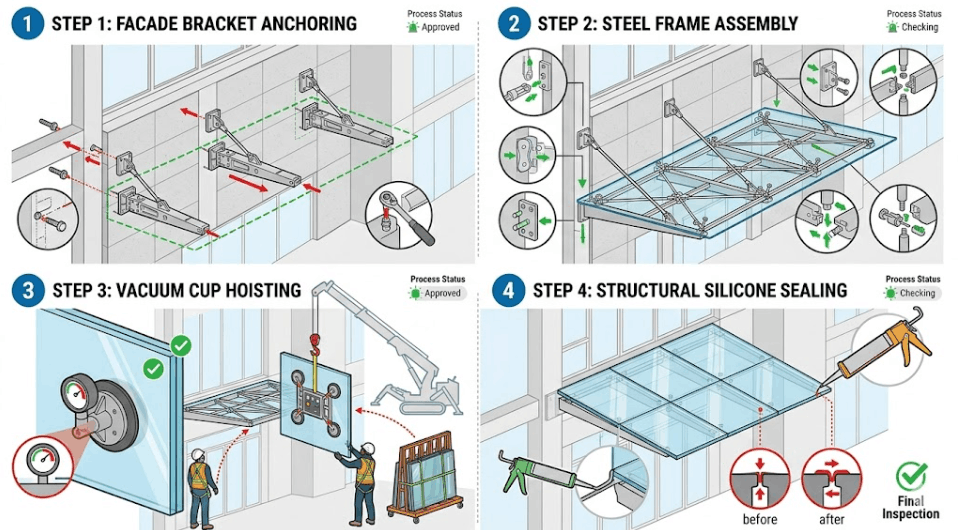
To avoid costly delays and safety incidents, a professional glazing team follows a strict, step-by-step installation sequence:
- Facade Inspection: Verifying that the building's structural backing (wood studs, concrete slabs, or steel beams) matches the engineered drawings.
- Bracket & Anchor Installation: Drilling and chemically anchoring the structural brackets to the wall, followed by torque testing to ensure load resistance.
- Framing & Hardware Assembly: Assembling the support framework, tie-rods, or spider fittings.
- Glass Hoisting & Placement: Using calibrated vacuum suction lifters to smoothly guide the laminated panels into position.
- Gasketing, Sealing, & Pitch Verification: Installing heavy-duty EPDM gaskets and applying structural silicone sealant along the joints. Technicians also double-check the downward slope (typically 2% to 5%) to ensure flawless water runoff.
Related Canopy Projects
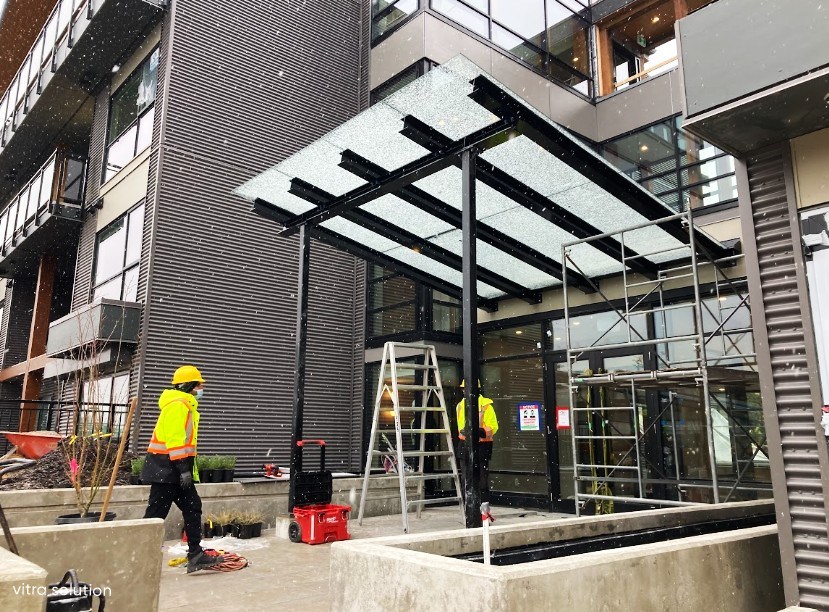
The Lloyd
Main entrance overhead glazing secured exclusively with heavy-duty standoffs for strict OBC compliance.
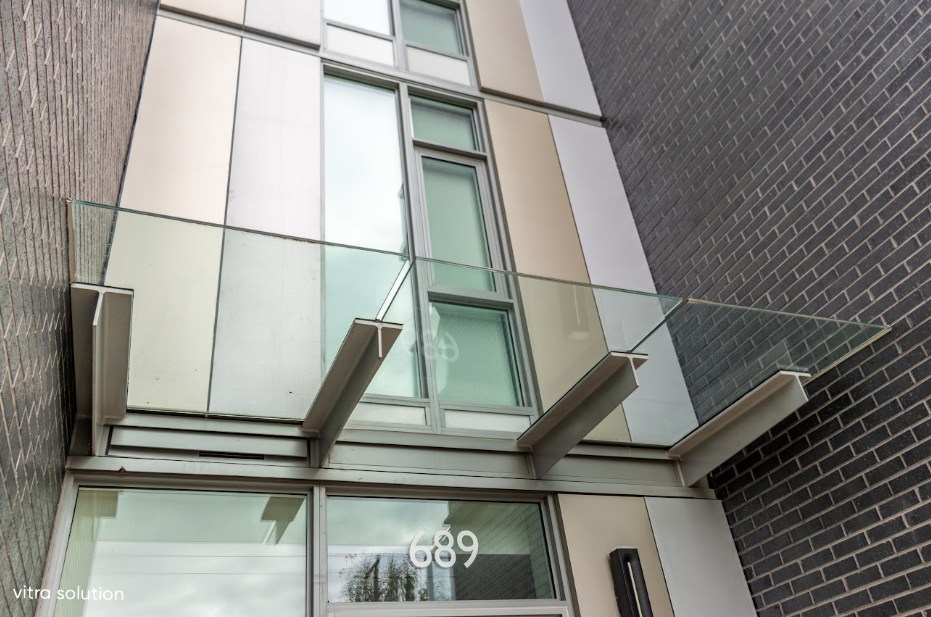
Coastal Health Entrance
Healthcare facilities benefit from maximum natural light. This entrance canopy was fabricated using ultra-clear low-iron glass.