
Glass Interlayers in Laminated Glass: The Architectural Guide to Safety and Structural Performance

When designing modern buildings, glass is often expected to do the impossible: remain completely transparent while acting as a robust structural barrier. From sweeping glass canopies to sleek frameless glass balconies, the demand for clear, strong, and safe glass has never been higher.
While tempering glass makes it physically stronger, the true secret behind the safety of modern architectural glass lies hidden inside it. This invisible hero is the interlayer used in laminated glass.
In this guide, we will dive deep into what glass interlayers are, compare the two industry-dominant types—PVB and SGP—and explain how to choose the right one for your building project.
1. What Is an Interlayer in Laminated Glass?
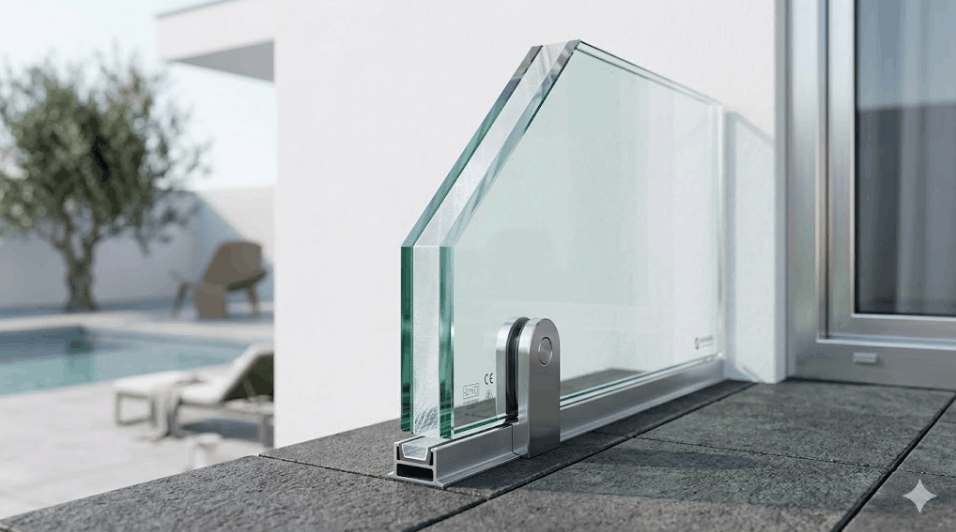
Laminated glass is essentially a "glass sandwich." It consists of two or more panes (plies) of glass bonded together by a tough, transparent polymer sheet called an interlayer. This bonding is achieved using a combination of high heat and extreme pressure in an autoclave.
The primary purpose of an interlayer is to control post-breakage behavior:
- Shard Retention: If the glass breaks due to an impact, the sharp fragments do not fly apart or fall down. Instead, they adhere firmly to the polymer interlayer.
- Fall-out Protection: The interlayer keeps the glass sheet intact within its frame, preventing people or objects from falling through the opening.
- Residual Strength: Even after shattering, laminated glass retains some temporary structural capacity, keeping the barrier functional until it can be safely replaced.
2. PVB vs. SGP: The Two Crucial Interlayer Technologies
While several polymers can act as interlayers, two materials dominate the architectural glass industry: PVB (Polyvinyl Butyral) and SGP (SentryGlas® Plus). Understanding their differences is key to specifying the right performance level for your project.
PVB (Polyvinyl Butyral) – The Reliable Industry Standard
Introduced in the 1930s, PVB is the most widely specified interlayer in the world. It is highly flexible, tough, and offers excellent optical clarity.
- Key Strengths: Great adhesion to glass, superb sound-dampening (acoustic) properties, blocks up to 99% of harmful UV rays, and is highly cost-effective.
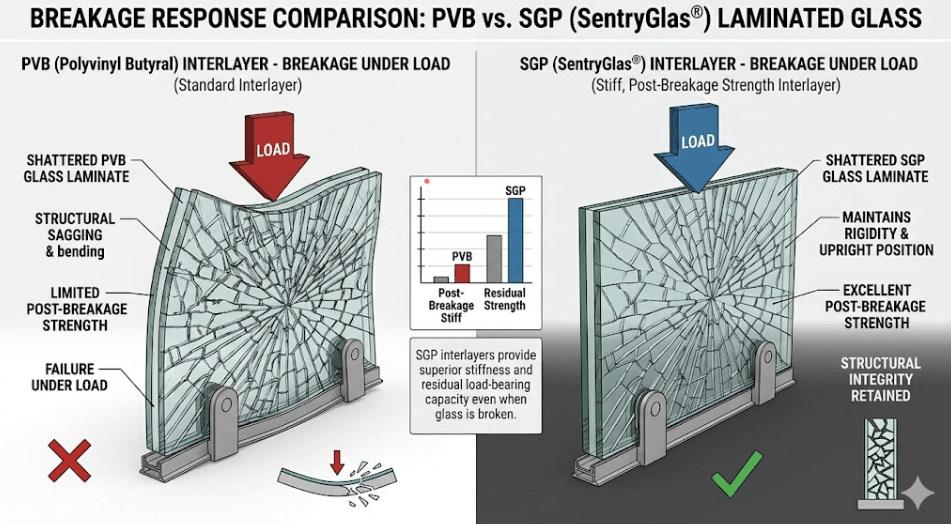
- Limitations: PVB is relatively soft and flexible. If both glass panes break, a PVB laminate will lose its structural rigidity and sag or collapse like a wet blanket. It is also sensitive to moisture; if its edges are exposed to the elements, it can delaminate (peel) over time.
- Best Uses: Standard glass railings with handrails, interior partitions, acoustic windows, skylights, and traditional building facades.
SGP (SentryGlas® by Kuraray) – The Structural Powerhouse
SGP is a structural-grade ionoplast polymer interlayer. It was engineered specifically to address the structural limitations of PVB in high-performance architectural designs.
- Key Strengths: It is 100 times stiffer and has 5 times the tear strength of standard PVB. It offers incredible moisture resistance, meaning it will never cloud or delaminate, even when its edges are completely exposed to the outdoors.
- The Magic of Post-Breakage Strength: If both glass panes laminated with SGP shatter, the stiff interlayer remains upright and rigid, acting as an active structural barrier even after total glass failure.
- Best Uses: Frameless glass railings (without handrails), glass canopies, hurricane-resistant windows, glass floors/stairs, and high-load structural facades.
3. Side-by-Side Comparison: PVB vs. SGP
Performance details of both interlayer systems are compared in the table below:
| Performance Metric | SGP (SentryGlas®) | PVB Interlayer |
|---|---|---|
| Material Type | Ionoplast (Structural Ionomer) | Polyvinyl Butyral (Standard Polymer) |
| Relative Stiffness | 100x Stiffer | 1 (Baseline) |
| Tear Strength | 5x Stronger | Baseline |
| Post-Breakage Rigidity | High (remains standing and rigid) | Low (sags/collapses easily) |
| Edge Stability | Extremely resistant (ideal for open edges) | Sensitive to moisture (clouding at edges) |
| Acoustic Performance | Good, but stiffer | Excellent (natural sound dampening) |
| UV Protection | Blocks ~99% | Blocks ~99% |
| Cost Profile | Premium (approx. 2x to 3x the cost of PVB) | Economical |
4. Why the Interlayer Matters for Safety and Code Compliance
When specifying glass barriers, safety codes (such as the International Building Code or the Ontario Building Code) focus heavily on what happens after the glass breaks.
The Problem with PVB in Open-Edge Railings
Imagine a modern balcony with a frameless glass railing. If someone falls against a glass panel laminated with PVB and both glass layers break, the PVB sheet will bend and slip out of the base shoe, offering almost no resistance. Because of this behavior, building codes in many regions mandate that if you use PVB, you must install a top handrail to catch people if the glass fails.
The SGP Advantage
With SGP, the glass panel remains standing upright even after both plies break. It maintains its structural integrity as a solid wall until replacement crews arrive. This high residual strength is why engineers can safely specify fully frameless glass railings without handrails, achieving a perfectly clean, minimalist aesthetic while meeting strict safety codes.
Related Glazing Projects
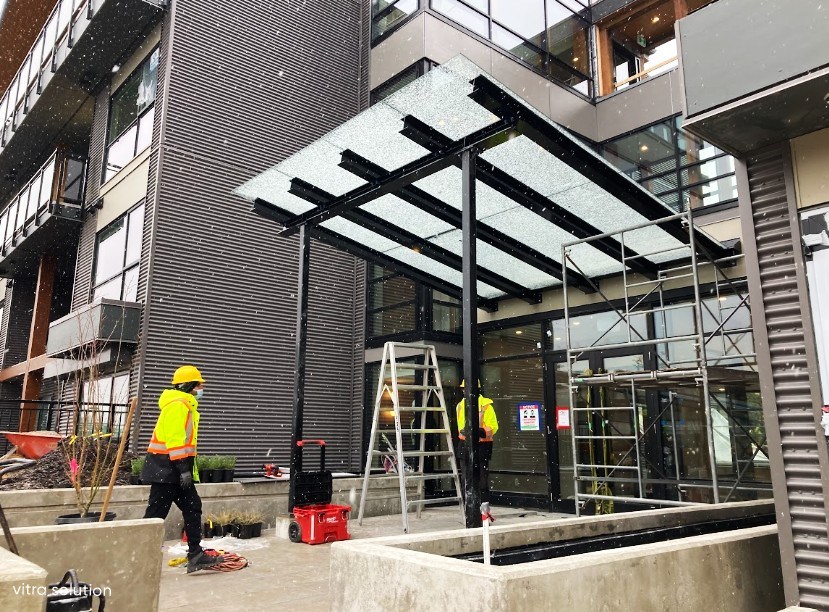
The Lloyd
Main entrance overhead glazing secured exclusively with heavy-duty standoffs for strict OBC compliance.
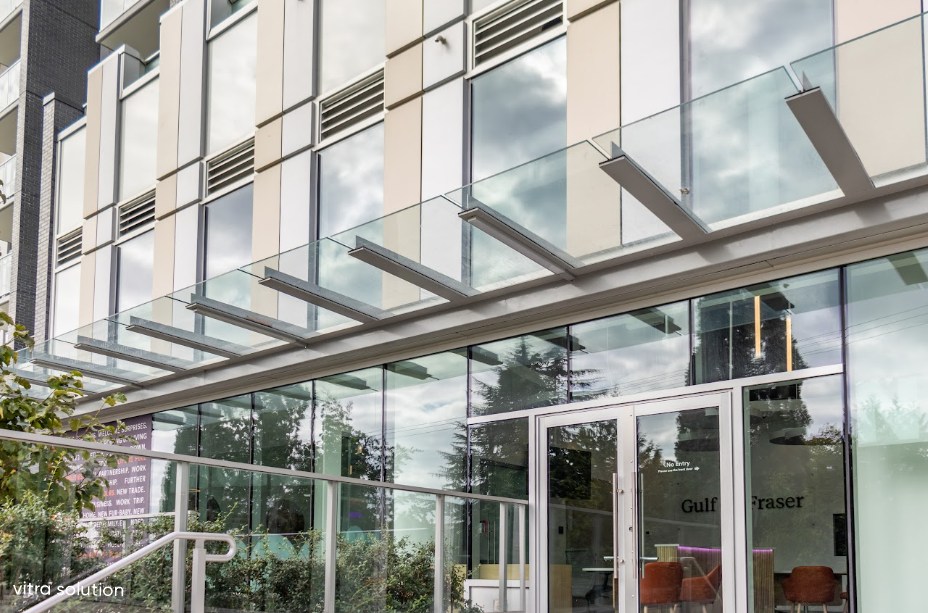
Cambie Garden CRU
Laminated glass panels integrated within a thermally broken aluminum framing system for retail storefront glazing.
5. Architectural Applications: Choosing Your Interlayer
Selecting the right interlayer comes down to balancing structural requirements with budget constraints.
Use PVB For:
- Acoustic Windows: Excellent for reducing street traffic noise in downtown condos and offices.
- Standard Framed Glazing: Perfect for windows, interior office partitions, and storefronts where the glass is fully supported by a frame on all four sides.
- Budget-Conscious Railings: Safe and economical for balcony railings that feature a continuous metal handrail on top.
Specify SGP For:
- Frameless Open-Edge Railings: Highly recommended for outdoor balustrades where the top glass edge is exposed to wind and rain.
- Glass Canopies & Skylights: Overhead glass requires maximum tear-resistance to prevent glass shards from falling onto pedestrian paths below.
- Hurricane & Security Glazing: SGP is tough enough to withstand impact from flying debris and resist forced entry attempts.
- Structural Glass Stairs & Floors: Where carrying live loads is a daily structural requirement.