
Laminated Glass Panels: The Builder & Contractor's Guide to Safety, Code, and Performance

For modern builders, general contractors, and glazing installers, specifying the right materials is the difference between a highly successful, code-compliant project and a costly structural failure or liability nightmare. Among all high-performance architectural materials, laminated safety glass has become a non-negotiable standard for structural barriers, overhead glazing, and high-security zones.
Unlike standard tempered glass, which is prized purely for its break pattern, laminated glass is engineered for post-breakage integrity—a critical factor in modern building envelopes and fall-protection systems.
In this comprehensive, industry-focused guide, we break down what contractors and builders need to know about laminated glass specifications, structural makeups, installation challenges, and on-site handling.
1. What Is Laminated Glass & How Is It Fabricated?
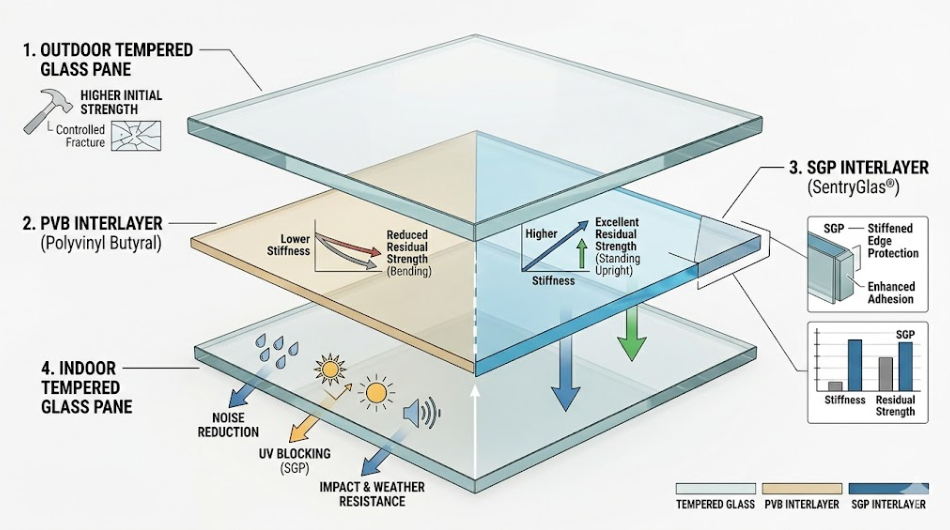
Laminated glass is a composite safety material engineered by bonding two or more layers (plies) of glass together with a tough, transparent polymer interlayer.
The manufacturing process involves three crucial phases:
- Precision Cutting & Drilling: The individual glass plies are cut, polished, and pre-drilled (if hardware holes are required) prior to lamination.
- Assembly: The polymer interlayer sheet—typically PVB (Polyvinyl Butyral) or structural SGP (SentryGlas®)—is sandwiched between the glass plies in an ultra-clean, dust-free environment.
- Autoclaving: The assembled panel passes through an industrial autoclave chamber. Under intense heat (approximately 140°C) and high hydraulic pressure, the polymer melts and chemically bonds with the glass surfaces, achieving perfect optical transparency and structural adhesion.
If a severe impact fractures the glass, the broken fragments remain chemically bonded to the tough interlayer rather than falling or flying apart. This is a vital property widely leveraged in high-end Glass Railings.
2. Choosing the Right Makeup: Annealed vs. Heat-Strengthened vs. Tempered Laminated
One of the most common mistakes contractors make is assuming all laminated glass panels are structurally identical. The structural performance of laminated glass depends heavily on the heat treatment of the glass plies used to make it:
Annealed Laminated Glass
Made from standard raw glass. If broken, it forms large, soft cracked patterns that stay on the interlayer. It is best for office partitions, standard windows, and interior storm doors where thermal stress is low.
Heat-Strengthened Laminated Glass
Heat-strengthened glass is twice as strong as annealed glass and has a unique break pattern: it breaks into larger pieces from edge to edge. In overhead canopies or facades, if the glass breaks, the large fragments lock together mechanically within the frame. This provides excellent residual strength, preventing the panel from sagging out of its metal support channels.
Tempered Laminated Glass
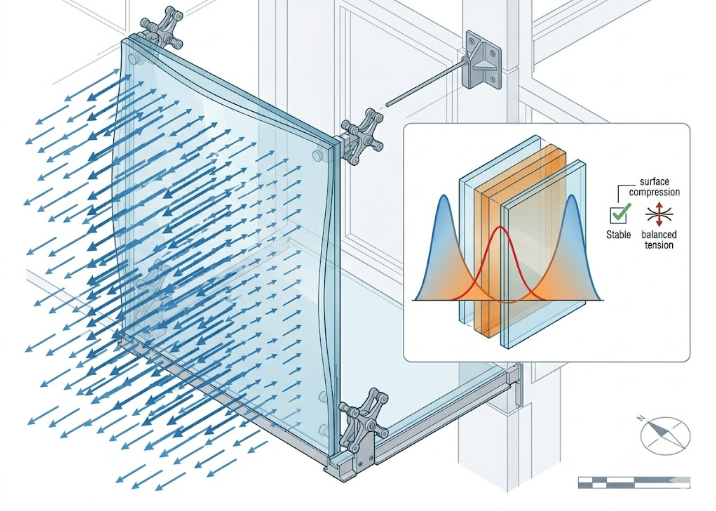
Tempered glass is up to five times stronger than standard annealed glass. This is essential for point-supported systems, structural glass floors, and frameless glass railings where the glass must handle heavy localized point-loads and impact forces.
Substrate Comparison & Mounting Suitability
Understanding which substrate combination works best for specific construction applications is critical to safety and cost efficiency. Review our comparative guide below:
| Substrate Combination | Structural Strength | Post-Breakage Rigidity | Best Application |
|---|---|---|---|
| Annealed + Annealed | Low | Low (pliable) | Office partitions, soundproofing |
| Heat-Strengthened + HS | Moderate | Maximum (ideal for framed overheads) | Skylights, sloped curtain walls |
| Tempered + Tempered | Maximum | Moderate (safely crumbles into tiny pieces) | Frameless railings, structural steps |
3. Key Performance Advantages: Security & Acoustics
While safety is the primary driver, laminated glass provides two massive secondary benefits that contractors can leverage to add value to their projects:
High-Performance Security
Standard tempered glass can be easily bypassed by intruders; a single hard strike shatters the entire panel instantly, leaving an open entry. Laminated glass, however, acts as a physical deterrent. Even under continuous, heavy blows from crowbars or hammers, the tough interlayer resists penetration. This delayed entry is why laminated glass is specified for high-end storefronts, banks, and jewelry display cases. Multiple-layer laminates can even be engineered to meet bulletproof and blast-resistant standards.
Elite Acoustic Control (STC Ratings)
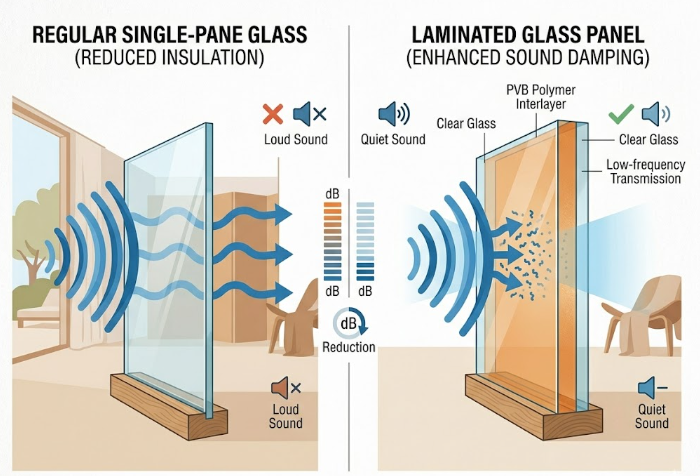
Sound waves easily pass through standard monolithic glass by causing the panel to vibrate. Laminated glass breaks up these sound waves. The soft polymer interlayer acts as a shear-damping core that absorbs acoustic energy. Integrating laminated glass into building facades or interior meeting rooms can elevate the Sound Transmission Class (STC) rating of a window assembly from a baseline of 28 to over 38 to 40 dB, dramatically reducing exterior street noise and improving privacy.
4. Crucial Installation & Handling Considerations for Contractors
Installing laminated glass requires higher precision and stricter on-site care compared to standard glazing systems. Contractors should always plan for the following variables:
- Managing Increased Dead Loads: Laminated glass is heavy. A 12mm laminated panel (consisting of two 6mm plies and a 1.52mm interlayer) weighs approximately 30 kg/m² (6.1 lbs/ft²). Installers must verify that the supporting framework, wood framing blocking, or concrete substrate has the structural capacity to handle these substantial dead loads.
- Edge Protection & Delamination Risks: The exposed edges of laminated glass are its most vulnerable points. If rainwater or moisture is allowed to pool continuously along a standard PVB laminate edge, the polymer will slowly absorb water, leading to clouding and edge delamination. Additionally, contractors must avoid using acidic, alkaline, or solvent-heavy construction sealants near laminated edges. Only use certified, neutral-cure structural silicones to prevent chemical breakdown of the interlayer bond. This chemical compatibility is critical when engineering glass barriers and Glass Guardrails.
- Glass Staging on Site: Never stack laminated panels directly on concrete, steel, or hard ground. Always use padded wooden blocks, rubber mats, or specialized A-frame racks. Protect the edges from any metal-to-glass contact during hoisting and maneuvering.
Related Laminated Glass Projects

8th Floor Terrace Guardrail
Custom 16mm laminated fritted glass panels combining safety, durability, and modern architectural design for a high-rise exterior.
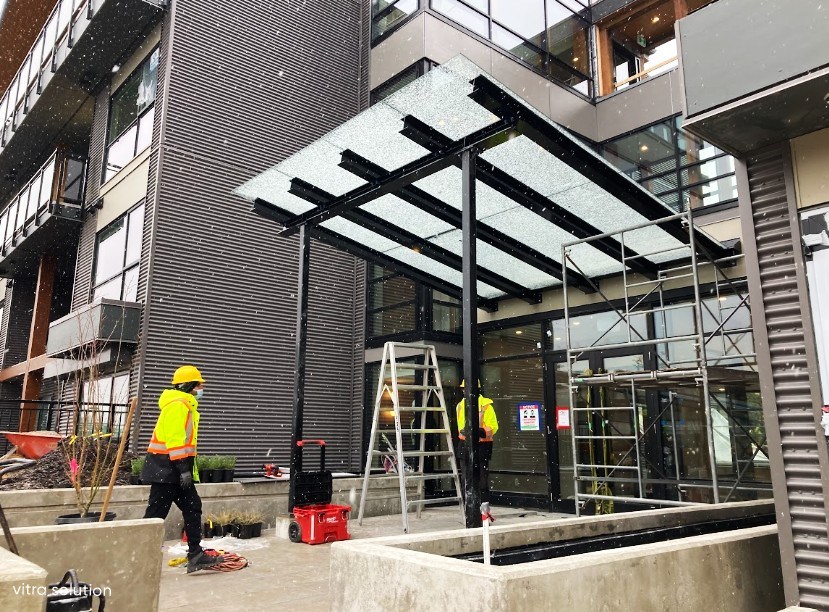
The Lloyd Entrance Canopy
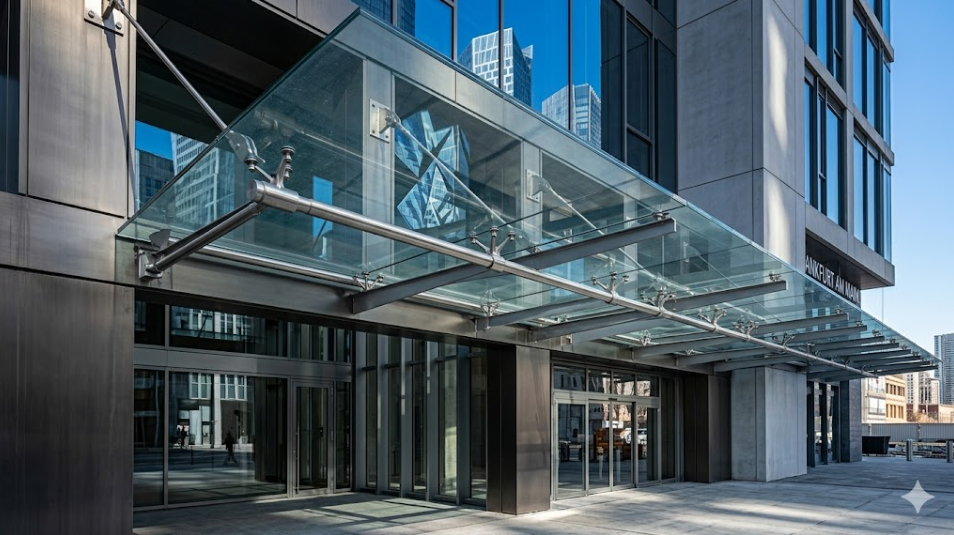
Main entrance overhead glazing featuring 12mm laminated tempered glass panels secured with heavy-duty stainless steel standoffs.
5. Partner with a Trusted Glazing Specialist
Successfully delivering a project with high-performance structural glass requires seamless coordination between contractors, engineers, and fabricators. To achieve maximum protection and weather integrity, we often recommend pairing laminated elements with specialized Balcony Privacy Glass configurations.
At Vitra Solution, we act as your dedicated glazing partner across Toronto and the GTA. We supply and professionally install code-compliant, precision-fabricated laminated safety glass systems customized to your specific structural and aesthetic requirements. Contact our team today to review your project specs, request physical glass samples, or receive an engineered cost estimate.